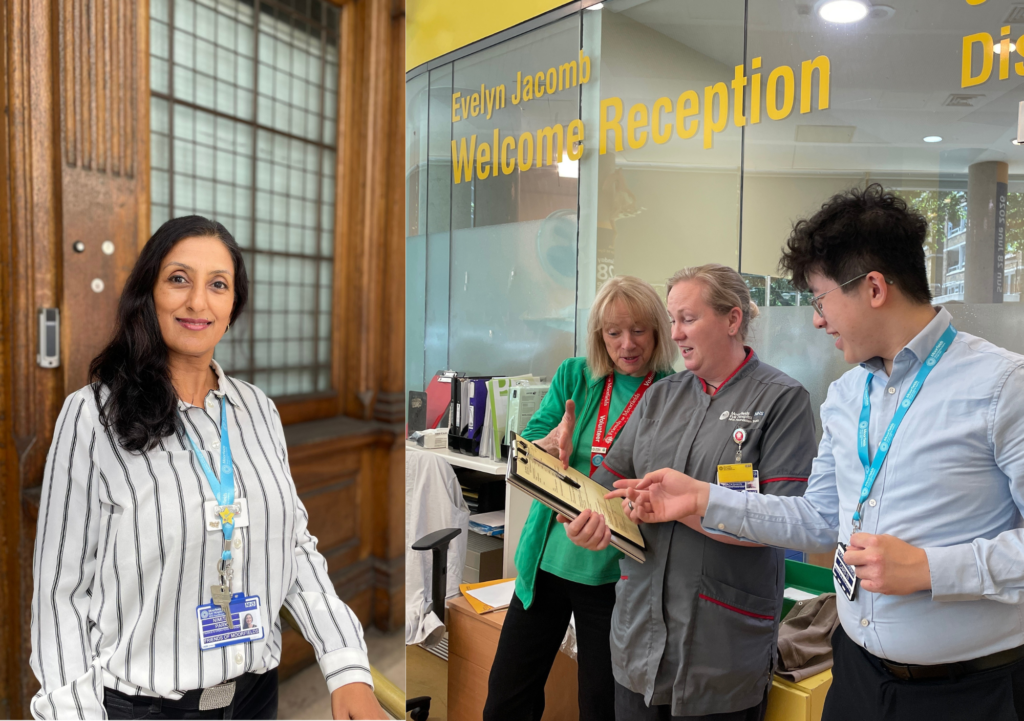
Almost 42% of our volunteer force is made up of people under the age of 25, and our Volunteer to Career programme gives them an invaluable experience at a world-class centre of excellence for eye care, research and education. But not everyone is able to commit to 6 months of volunteering.
We sat down to chat with Nimita, the newly appointed Youth Engagement Manager at Friends, about how we’re going to support even more young people through our work experience programme.
To start things off, can you tell us a bit about the programme?
The work experience programme is a short, 1-to-2-week programme to give young people between 16-to-19 years old a taster of the opportunities in healthcare, and in particular in eye health. It replaces the work experience programme currently ran by Moorfields Eye Hospital.
Their days will consist of 2-to-3-hour slots with different departments, and their experiences will range from shadowing a clinic, department or volunteer at work, to attending presentations/events or group work with medical students, to activities such as research tests in electrophysiology.
We are working closely with Moorfields Eye Hospital, UCL Institute of Ophthalmology, NIHR Moorfields Biomedical Research Centre and the Young Person’s Advisory Group (YPAG) to offer students a varied experience.
The Friends normally focus on patient experience. Why are we introducing a workplace experience programme? And why now?
With the move to Moorfields and UCL Centre for Eye Health in mind, we have an incredible opportunity to find new ways to support communities, including students in our area and beyond.
I’ve got two teenagers myself and I’ve seen them and their friends struggle with career choices. Even if they know which direction they want to go in, they don’t know about all the opportunities out there. And if they do, they can’t find work experience. There are so many closed doors.
It’s tough for young people out there. At Moorfields, we have the chance to change this for the healthcare sector. The workplace programme might not have an instant impact on patient experience, but it will have a direct impact in the long term. We need good staff. What better place to start looking for future colleagues than amongst young people embarking on their career journeys.
There’s a certain buzz around Moorfields. People are kind. And it’s a place where you can grow beyond the role you are hired for. At the age of 16-19, students are taking decisions that lay the foundations of their career path, so it’s a critical age to scout for talent and show them what Moorfields can offer them.
How are staff getting involved in the programme?
Our colleagues are busy. The programme is designed to avoid adding anything extra to their plates. There is no preparation or curriculum design required.
Students are shadowing staff at work, taking part in existing research projects, and coming along to planned talks, group work and events.
Simply observing patient interactions and being immersed in a healthcare environment is already an invaluable experience.
What is your vision for the programme in the long term?
That’s simple: watching students become part of the Moorfields family. It would be amazing to see people go into eye care and perhaps even volunteer with us!
We want to scale the programme. I’ve been approached by many colleagues about opportunities for their children or a young person they know. We currently don’t have the capacity to take on everyone, but as more departments sign up, we can host more students. If work experience isn’t quite right, Friends can be an entry point to connect students up with YPAG initiatives or to get them to consider studying at the UCL Institute of Ophthalmology.
In the long-term, we also intend to expand the programme beyond the focus on medical students. Everyone has a skill and you don’t need to be a medical specialist: Moorfields is for everyone.
Participants will get the word out to students who might not have considered Moorfields and the programme, and through this increase our reach. This will hopefully further increase the demand for the programme and allow us to expand the service to different sites.
Applications for this year’s cohort have now been closed. Keep an eye on our website for more information about future work experience programmes. We will be closely evaluating our next steps but look forward to working with even more departments and colleagues for the next cohort.
Spotlight on…Moorfields at Bedford
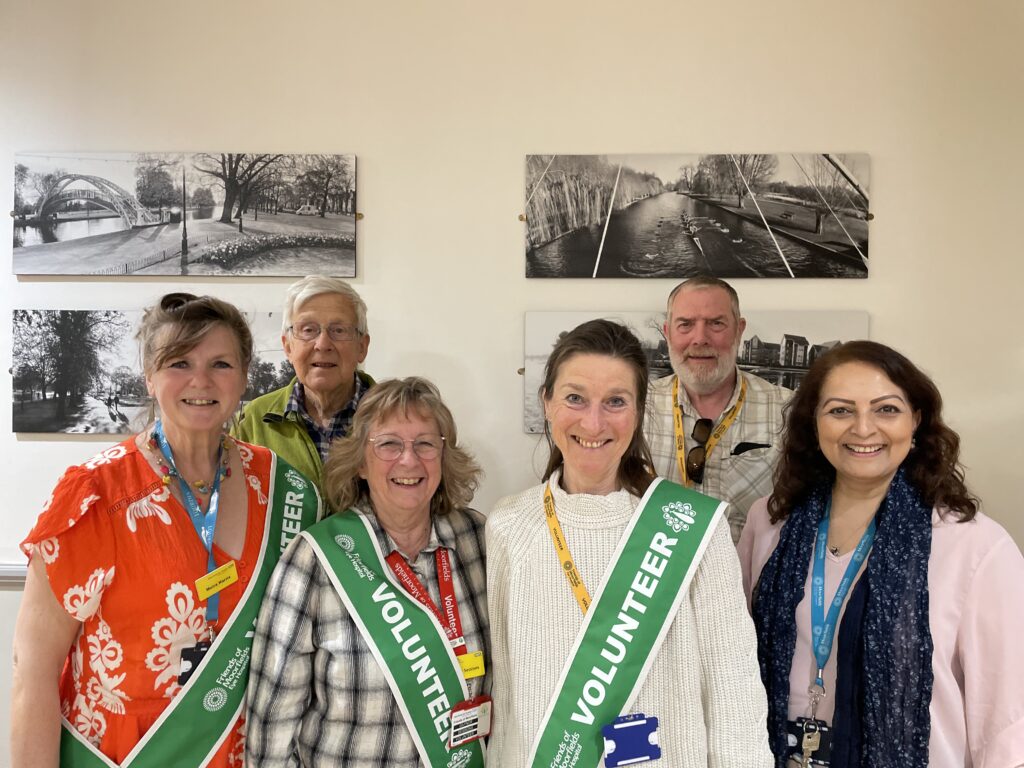
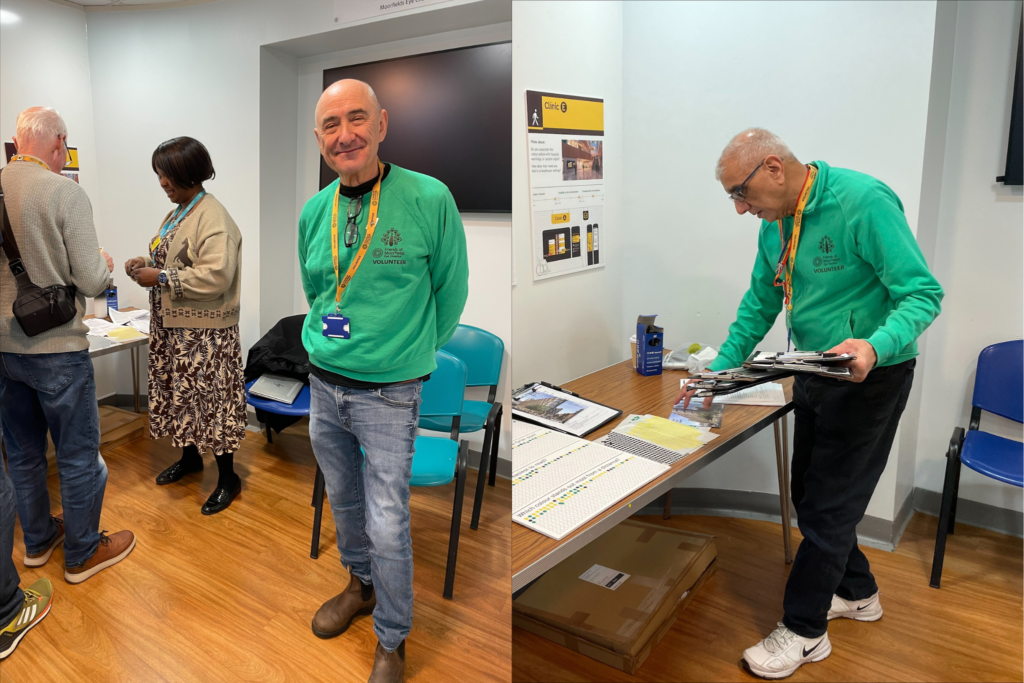
Despite being a smaller site, Moorfields at Bedford offers patients a wide range of outpatient clinics, complex surgery and a diagnostics hub. Staff describe our volunteers at this site as part of the fabric of Moorfields, but in return, volunteering also gives something back to them: a very special community.
Because they cover different shifts and don’t see each other during volunteering, our Bedford volunteers organise a coffee morning every month. We joined them in April and chatted about why they volunteer at Moorfields and what it’s like to be part of the Bedford crew.
“After I retired as a nurse, volunteering was my way to come back to the Moorfields family. I have been on both sides of the system: as a nurse it was my responsibility to deliver the best possible treatment and service, but as a volunteer, my sole purpose is looking after the patient. I love being able to help staff focus on delivering an excellent service because they don’t have to worry about who looks after the patient.” – Moira
“I started volunteering after the amazing treatment I received at Moorfields myself and have been involved in clinic and admin support here at Bedford for many years. It’s nice to be able to support on different things.” – Gaynor
“What’s really special is that Moorfields [at Bedford] is very communal. Everyone is respectful and generous about learning from each other. When you go into theatre, you have any culture in the world, working together in the same room as one. It’s really wonderful to be part of this team.” – Adrian
“The handholding role is something incredible, especially because holding someone’s hand is not something that comes natural to all patients. When people are anxious, I put them at ease by saying: ‘Look at it like I am a friend’. Jan Kuszlewicz was my inspiration – I want to follow his ethos of giving: I’m happy when I see patients are happy.” – Andrew
“What I love about volunteering at Moorfields is the team spirit. The medical staff truly appreciate the role volunteers play in helping patients feel calmer and taking the time to sit down with them. They [Moorfields staff] are incredible and always put the patient first, so they understand how spending time with patients is very much needed.” – Naomi
A special thank you to the wonderful Pauline who is taking a break from volunteering. We can’t wait to welcome you back!
Are you a student considering a future in eye care, clinical research, or ophthalmology? The Friends of Moorfields Eye Hospital and the NIHR Moorfields Biomedical Research Centre invite you to take part in our very first essay competition.
The theme is personal reflection. We want to hear what inspires your ambitions for a career in eye health. Whether it is a personal experience, an interesting medical topic, or an inspiring individual, we want to read your story.
Categories
Category 1: Post-graduate students at the Institute of Ophthalmology and early career medics
Category 2: Undergraduate students at the Institute of Ophthalmology and Moorfields Education medical students
Category 3: Student volunteers at Friends of Moorfields considering a future in eye health
The prize
The prize winners will receive a £100 cash prize and the opportunity to attend and present an extract of their essay at the Future of Eye Conference on 17 October 2026.
The requirements
Our expert judging panel is looking for a well-structured, clearly articulated essay of >1,500 words, showcasing your unique point of view, good grammar, and topic understanding. If you use secondary sources, please reference them in APA style. We want your authentic voice, so AI-written essays will not be accepted. Because these are personal reflections, entries will not be published, and it is not compulsory to do a reading at the prize giving.
Key dates and information
Entries open in June and close on Friday 4 September 2026.Email your entry to moorfields.friends@nhs.net. Please use the exact subject line format [Category] [Your name] Essay Submission.
We look forward to reading your unique stories!
A true community: St. Ann’s at Moorfields
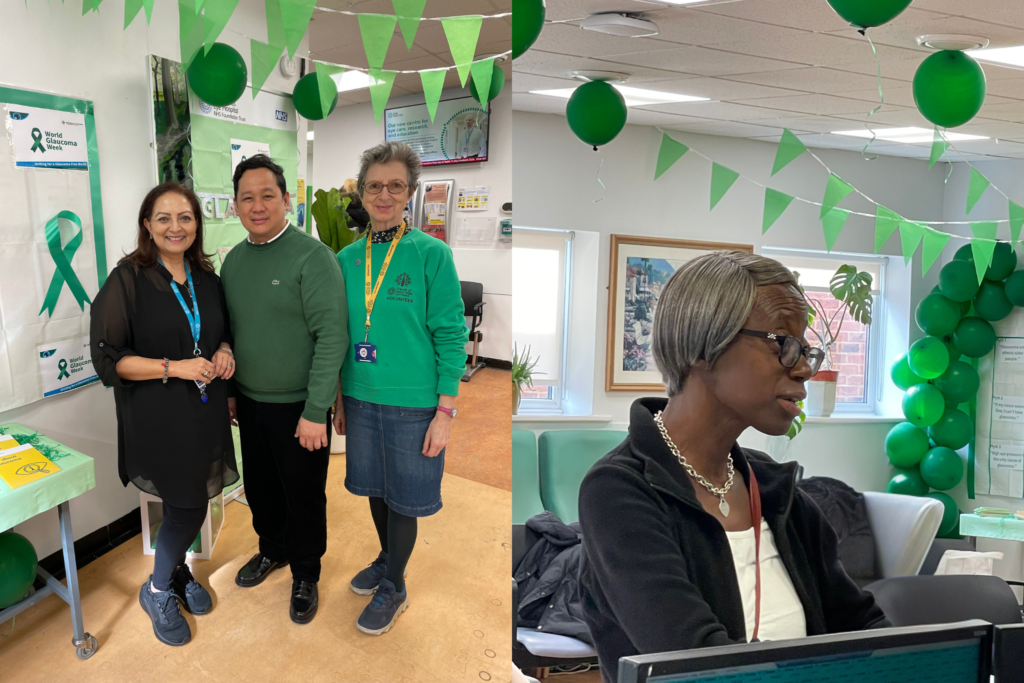
Moorfields operates out of 20 different centres, and each and every one of these is unique. Friends are present at 10 sites, but we’re always looking to expand our operations to better support staff and patients. This March we took a peek behind the scenes at St. Ann’s, during a World Glaucoma Week awareness event.
What makes St. Ann’s special? When you walk through the doors, it instantly feels like a community; it’s a welcoming environment with lovely and approachable staff, and personal touches such as artwork by a patient in the hallway.
St. Ann’s is proof of how kindness and excellence shape patient experience. A survey conducted in October and December 2025 found 96% of patients would recommend St. Ann’s to anyone who needs similar care, and 100% would recommend the centre for surgery.
Patients at St. Ann’s can get cataract, glaucoma and medical retina treatments, including surgery. Despite being a smaller site, it’s very busy; the team see about 200 patients a day on average.
Everyone goes out of their way to put patients at ease and guide them to and from their seat. But there isn’t always enough time for those who need more. When we asked staff what could make the St. Ann’s experience even better, they all agreed: regular volunteers!
“Volunteers are key in improving the patient flow, but also in building community: a chat whilst you’re waiting can make all the difference.”
The sense of community is something close to heart for the staff at St. Ann’s. When their colleague Gino suddenly passed away in 2024, the team led an initiative to plant a community garden to remember him. Friends funded a memorial bench and some additional tables to help create an outdoor space to support the staff’s wellbeing.
Wellbeing goes beyond the here and now. As much as our volunteers support staff, volunteering itself can also be a form of support, meeting new people and building community. We spoke to a colleague at St. Ann’s, who was keen to give back to the trust to develop new skills.
“I was a technician for 3 years and then moved into an admin role. But I like learning and getting skilled in different areas. Volunteering offers that opportunity.”
We’re excited to keep providing opportunities to connect patients, staff and the general public at St. Ann’s and through Moorfields in general! Do you want to support this wonderful site as a volunteer or are you a staff member wanting to volunteer? Get in touch with our office or email moorfields.friends@nhs.net.
Work on Moorfields and UCL Centre for Eye Health (Oriel) in St Pancras, Camden, is progressing well and the centre will welcome its first patients in summer 2027.
All services at Moorfields Eye Hospital City Road, the children’s services and Moorfields Private on Bath Street, will move to the new centre.
Our volunteers are supporting the Oriel programme team to help transition our staff, students, and patients to the new site. They will be out and about in clinics at City Road, sharing key information with patients. This will include information about how to get to the new site and what facilities will be available.
The team will also encourage patients to take part in other engagement activities, including wayfinding, and digital services. We’re keen to hear feedback from as many patients as possible to help us create a centre that is accessible for all.
Our Oriel volunteers are vital to the relocation, and will continue to provide support once we’ve moved in. We asked a few of you to share your thoughts about the move and role of volunteers.
What made you want to become an Oriel volunteer?
Kiran: “I’ve been volunteering with Friends for five years and have a background in project engineering. I was part of another large move, so I got really excited when I heard about Oriel.”
Ian: “I have an eye condition myself and understand how important it is for the first experience with an unfamiliar place to be a positive one. Volunteers are key to creating that positive environment and that is great to be involved in.”
What are Oriel volunteers working on right now and how does it help patients?
Kiran: “We want everything to go as smoothly as possible, so we need to make patients aware of the move and collect their feedback at these early stages. It will make everyone’s life easier once we move.”
Ian: “There is something extraordinary about Moorfields, because volunteers get involved across the patient experience. It’s a complex transition, and having trained volunteers in place will help communicate updates clearly.”
What excites you most about volunteering at the new centre?
Kiran: “A new environment will present challenges and it’s a joint responsibility – Moorfields, UCL, the charities and all others involved – to make sure we leave a good first impression. But we are ready for it!”
Ian: “Whether you’re staff, a patient or volunteer, there is an emotional attachment to this hospital. We get to be part of preserving the spirit of Moorfields, but also in taking things forward. There are so many opportunities!”
If you would like to find out more about the new centre, visit the Oriel page on the Moorfields website or email moorfields.oriel@nhs.net to sign up to the Oriel newsletter.
If you are a volunteer and would like to get involved as an Oriel volunteer, get in touch with Liam Bays, Oriel Project Delivery Manager (liam.bays@nhs.net).
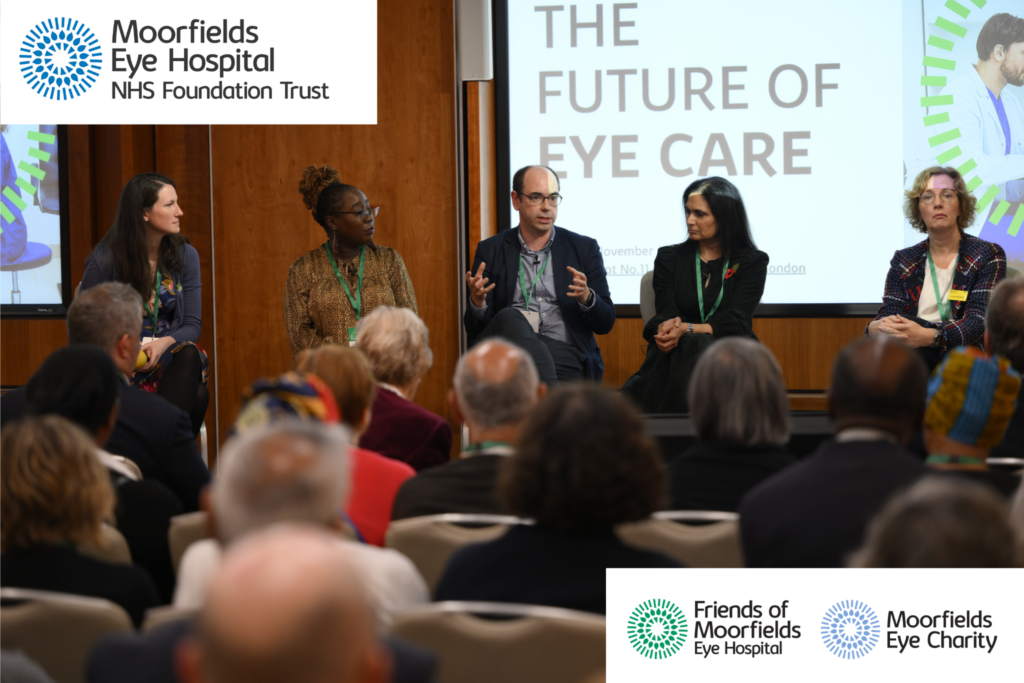
Save the date: the Future of Eye Care Conference is returning on Saturday 17 October!
This year, Moorfields Eye Hospital, Friends of Moorfields and Moorfields Eye Charity are partnering to bring you up to speed about the latest in research, technological innovation and other progress in eye care at Moorfields and beyond.
Prepare for a day filled with expert talks, panel discussions and an exciting exhibition space with innovative products and services for people with sight problems.
Tickets will be available soon. Keep checking our website or follow us on social media for updates on speakers and exhibitors.
We are excited to share that name of the new, world-class centre for eye care, research and education will be ‘The Moorfields and UCL Centre for Eye Health’
This is a name that recognises the powerful partnership between Moorfields Eye Hospital, the UCL Institute of Ophthalmology and Moorfields Eye Charity. Friends of Moorfields has been a proud supporter and with your help we have contributed £1million to the project.
The name of the centre describes the partnership, emphasising collaboration and the combined expertise of the partners involved. Harnessing the expertise of clinicians and researchers under one roof, the centre will deliver the highest quality eye care, research, and education. With state-of-the-art facilities, patients will have access to more efficient treatments, as well as being able to take part in research more easily.
We will all continue to operate with our individual brands; Moorfields and UCL Centre for Eye Health is the building name only. This is an important milestone for the new centre that will serve communities for generations to come.
Friends support has helped turn a bold vision into a tangible reality and stands as a testament to what collaboration and philanthropy can accomplish together to achieve world-leading innovation and research in eye health. Designed with patients and sight loss organisations, the centre will offer state-of-the-art facilities, more efficient treatments and greater opportunities to take part in research. It will also include welcoming spaces for staff, volunteers and students to collaborate, recharge and innovate, including a roof garden.
An interview with Dr Karla Dias
When we talk about the future of eye care, we often think about research labs, the latest equipment and brand-new treatments – which are key to progress. But the best breakthroughs are also about people.
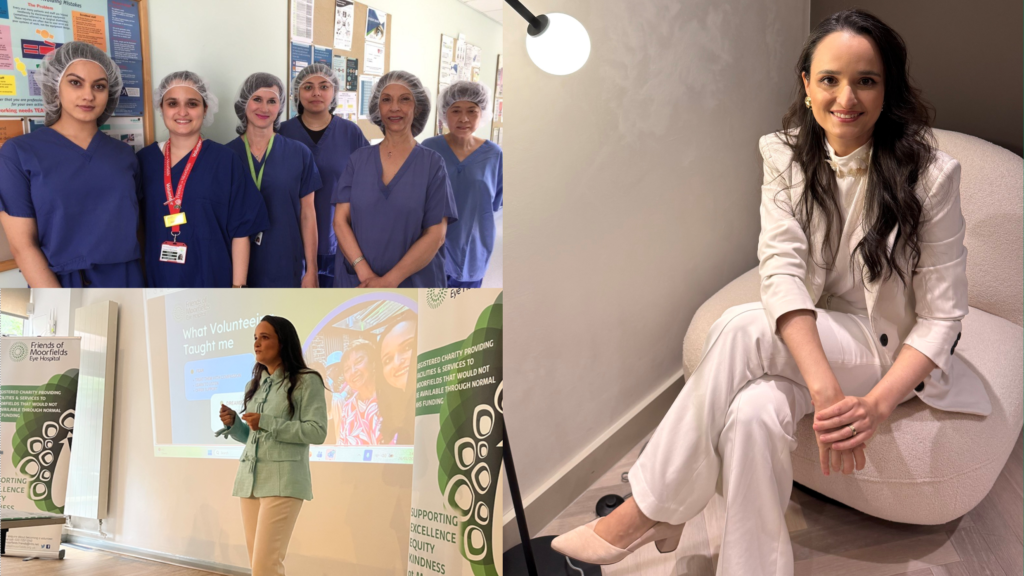
The wonderful Dr. Karla Dias has been with Moorfields for 7 years – 1 year as a volunteer and 6 as a doctor. Friends caught up with her about her background, how breakthroughs happen, and the future of eye care at Moorfields.
Can you tell us a little bit about your specialisation in eye care and your journey at Moorfields?
Thank you very much for inviting me. It’s always a pleasure to speak with the Friends! I’m an ophthalmologist with a particular interest in complex anterior segment disease and structural complications. My work focuses on patients whose eyes have lost their normal pressure and structural integrity. This can happen after surgery, inflammation or eye trauma.
My journey at Moorfields has been deeply formative. It began not only as a clinician, but also as a volunteer. As a volunteer I started with welcoming patients at the front. I would help them check in, guide them, and be there for them if they had questions.
“This experience shaped the type of doctor I am today.”
When you sit next to a patient as a volunteer, you hear different things about their fears of losing independence, their frustrations, and their hopes that someone might look at their case differently. And that perspective has always stayed with me.
At Moorfields, we work at this intersection of clinical excellence, research and compassion. I’m very grateful to have always been given the time to talk to patients, even when I’m in a very busy clinic.
Your relationship with Friends has recently gone full circle, as you are part of the team that was on the news about a new treatment funded by Moorfields Eye Charity, which Angela Smith, our chief executive, received as well. What is hypotony and how does the treatment help patients like Angela?
It’s been a great pleasure to be able to treat her! Hypotony is a condition in which the pressure inside of the eye becomes abnormally low. When this happens, the eye can collapse structurally, leading to distorted vision, changes in the retina, discomfort, and in severe cases, irreversible sight loss.
Low eye pressure is not just a number for many patients. It means blurred vision, fluctuation in the vision, difficulty reading, driving, recognising faces, and dealing with the emotional impact of limited options.
The treatment we developed involves injections inside of the eye with a gel-like substance that provides internal structural support. Rather than trying to increase the pressure by injecting liquid in the front part of the eye, this approach focuses on restoring the eye’s architecture from within, which can ultimately improve visual function.
“For patients like Angela, it represents a shift from ‘there is nothing that we can do’ to ‘there may be a way to help’.”
Can you talk a bit more about how the treatment came about?
Innovation begins with listening carefully to what’s not working. Conventional hypotony treatments aim to correct underlying causes. However, in some patients the eye’s structure remains unstable.
“When patients continue to have hope and ask whether there is another possibility, it challenges us as clinicians to look beyond established pathways. Innovation is often co-created with patients.”
The HPMC gel we use actually has long been used safely in ophthalmology, but the idea to use the gel to treat hypotony emerged from listening to a patient who was losing her vision. Mr. Petrushkin wanted to try everything he could to stop this from happening.
What role does addressing unmet needs, and the effort around rare diseases, play in driving innovation?
Rare and underrepresented conditions often receive less attention in research because they affect smaller populations. Yet for an individual patient, the impact is profound. When there is no treatment, no trial and limited literature, we must think more creatively and more collaboratively as clinicians.
At Moorfields, we work as a team: with patients, multiple clinics and different consultants and colleagues, who always have something to add. I’m respected for being unique and Mr. Petrushkin is respected for having his ideas.
“Being a voice for the patient that no one talks about means recognising that equity is not only about access. Equity is about ensuring that uncommon conditions are not dismissed and unsolvable simply because they are uncommon.”
Historically, some of the most transformative medicine began with rarer and challenging cases that forced us to think differently. When we allow lived experience to guide research priorities, innovation becomes concrete and purposeful.
The hypotony treatment is a good example. It began with a relatively small number of patients with a significant unmet need. But once you explore a solution, its principles may extend to broader applications.
If you had to name one thing, what excites you most about innovation at Moorfields?
If I had to put it into one word, it’s ‘mindset’. At Moorfields, there is a culture that allows clinicians and scientists to question assumptions. This environment, together with the exceptional research infrastructure, multidisciplinary collaboration, and many incredible people working here, creates the space for meaningful change.
“Kindness and innovation are not separate concepts. The future of eye care is not only about new devices and molecules; it’s about the human drive to change the outcomes for patients who feel forgotten or unseen.”
That moment that the patient who has been told for years ‘that nothing can be done’, hears ‘there may be something we can try’, that’s when true progress starts.
If you would like to listen to the full interview, please access the recording here.
At Friends of Moorfields, we want volunteering to be something that gives back to our volunteers too. Sometimes it leads to new friendships. Sometimes it leads to new skills. And sometimes even to a new career.
In 2025, we supported 30 volunteers in finding a new position at and beyond the hospital.Today we are chatting with Parul, who used to volunteer as a hand-holder, and has recently joined the Friends of Moorfields as a volunteer support officer.
Parul, can you tell us a bit about yourself and how you ended up volunteering at Moorfields?
“Sure! I was born in India but lived in Kenya most of my life. I got married and came to the UK in 1998 and worked for the Post Office and then the Post Office inside Co-op here in Old Street for 25 years. It was a customer-facing job that I was very passionate about, because I’m a people’s person.
But life changed and I took up a counselling course after my daughter passed away. This put me on a different journey altogether, which in turn led me to volunteering. I first volunteered with Age UK for two years, where I was a telephone befriender. It helped me apply my counselling skills, because you need a lot of empathy and compassion to understand somebody who is lonely and get them to open up to you.
So, here I was, in a really good mood about my course and then Fleur from Friends of Moorfields came into Co-op and she asked: ‘What are you so happy about?’ I told her about my course, she told me about hand-holding, and then one thing led to another.”
Thank you for sharing that. So how did volunteering tie in with your career aspirations?
“It was always my dream to work in a hospital, but my education took me in a different direction. I was excited about hand-holding being a patient-facing experience and going into the theatre. I had radial keratotomy when I was young; I didn’t know anything about the procedure. Now, I’ve seen doctors perform surgeries, I look things up, I read more about the latest procedures and what they can do against sight loss.
But what struck me most was the level of care I witnessed. I entered rooms full of people who were anxious about their procedures, but by simply asking them, ‘How are you today’, I could take some of that fear away from them.
Hand-holding became such a beautiful journey. I used my active listening skills from counselling. It’s incredibly rewarding to feel what a patient is feeling and then reframe their fears and give them that unconditional positive regard that they are in safe hands.
Volunteering became my favourite day of the week. I would never take a day off unless I couldn’t help it. I was more aligned with volunteering than I was with my job.”
How did you go about changing jobs?
“I tried applying for multiple roles at Moorfields, but none of them were quite the right fit for my experience. I remember seeing an email about the volunteer support officer job just before going to bed – and I wrote my application that same night with just my lamp on!
It was something that felt right, and I felt confident about: I had literally been in their shoes, I could support them, and I could understand their challenges.
I am very happy in my role and feel completely aligned. There are so many familiar faces: my customers from the Post Office have turned into colleagues and patients. It’s amazing to be part of the Moorfields team. Even as part of the charity, I feel very connected to Moorfields in every way.”
You’ve been on quite the journey; and that journey doesn’t feel finished yet!
“Yes, the journey continues through my counselling studies. I started at level 1 and am now at level 5. The hospital is offering me an opportunity to continue my work placement in counselling too. It feels like when I started on this journey as a hand-holder, I had no idea where I was going to end up. But my counselling has been the red thread throughout.
The volunteer support officer role has given me a different perspective, because I feel it incorporates it all. Because supporting volunteers is just as important as supporting patients or anybody at work. And that level of understanding I have now, I would not have had through just the course.”
That’s amazing. As a final question, if you had to pick one thing during your time as a volunteer that you’ve taken with you in your professional or even personal life, what would that be?
“The most valuable thing that I have taken from my experience was the level of compassion and empathy. That isn’t something that just comes overnight. It comes with practice. Just stepping into someone else’s shoes really isn’t that easy.
But once you do, you reach that level of empathy and compassion that allows you to truly connect with others. Supporting patients in theatre works on the same principle as building rapport with volunteers. You want them to feel they are valued. Volunteers don’t come in because they have to, but because they want to. It’s selfless. And that same kind of kindness is core to the level of care to patients at Moorfields.”
Are you interested in volunteering at Moorfields? Find our more and fill out the form on our website today!
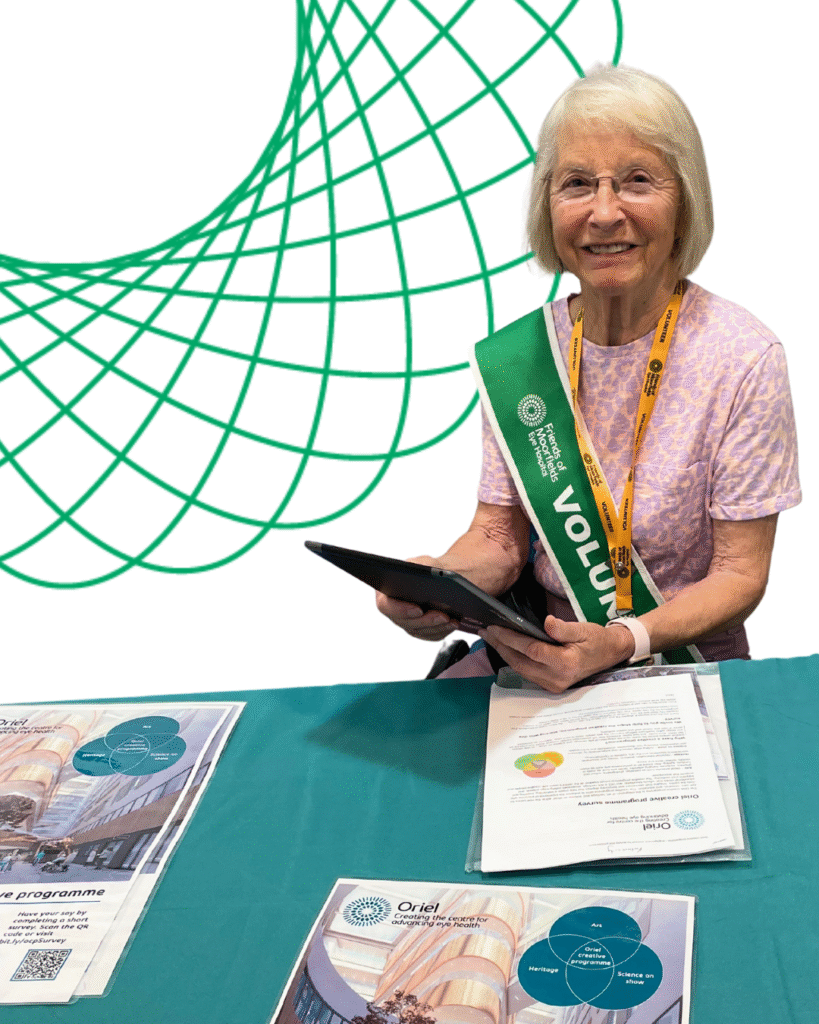
The results of the survey will help shape the creative programme for the new centre for eye care, research and education, opening in 2027.
This week, our volunteers have been talking to patients about the new centre for eye care, research and education – the future home of Moorfields Eye Hospital City Road and the UCL Institute of Ophthalmology, opening in 2027. The volunteers are sharing a survey that patients can fill in, to help shape the creative programme for the new centre.
The creative programme will bring together art, heritage and ‘science on show’ to enhance the experience of everyone who will use the centre. It will connect patients, staff, students, volunteers, supporters and the wider community with creative people and projects.
Our chief executive, Angela Smith, has been with Friends of Moorfields for ten years this week!
Over those ten years, we’ve seen incredible changes, from new initiatives like Volunteer to Career and our award-nominated handholding service, to the growth of our volunteer programme and our staff team, allowing us to support more patients than ever before.
During the last ten years we’ve played a vital part in supporting Moorfields during lockdown, we’ve celebrated our 60th anniversary, and we’ve held our first ever conference, exploring the future of eye care. We’ve given grants for initiatives like Christmas gifts for young patients, improvements to the ocular oncology counselling room, and an AI tool that helps predict the risk of keratoconus.
“I can’t believe it’s been 10 years already!” Angela said. “Time flies by… It has been an honour and a privilege to lead an amazing team who are all passionate about supporting Moorfields. I am very proud of what we have achieved.”
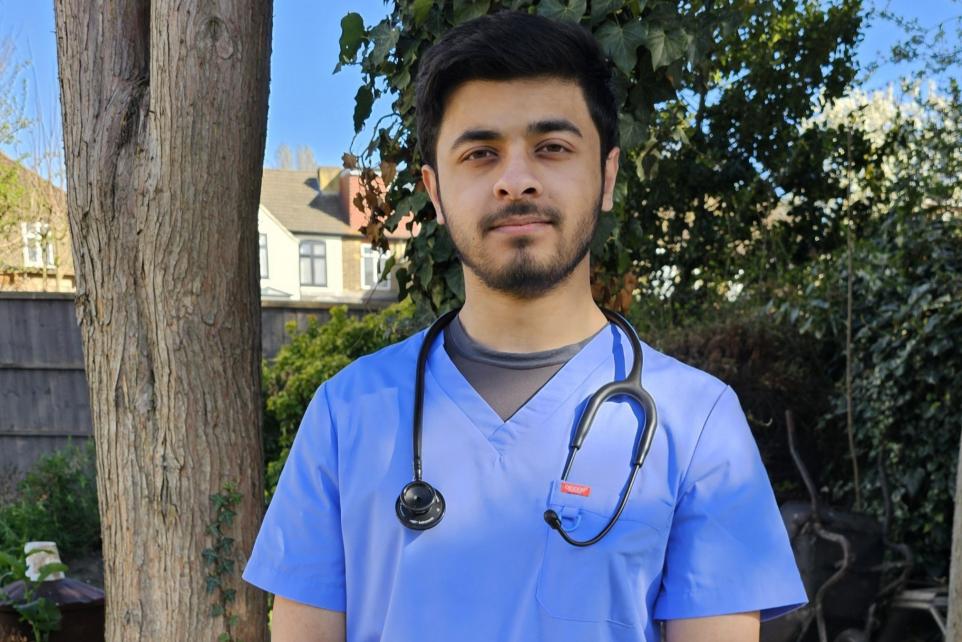
Raahat was inspired to pursue a career in eye health after getting hands-on experience and career guidance with Friends of Moorfields.
When East London student Raahat accompanied his grandad to an eye hospital appointment, he never imagined it could lead to him becoming a doctor, but thanks to the ‘Volunteer to Career’ programme, which he participated in as part of a volunteer role with Friends of Moorfields, he is now doing medical training with the aim of specialising in Ophthalmology.
The initiative, piloted by national charity Helpforce, is designed to harness the power of volunteering in tackling persistent recruitment issues across health services. It gives people who are interested in healthcare careers but don’t have a background in the field a chance to gain valuable experience and confidence before applying for paid roles or training.
Alongside 22-year-old Raahat, those who’ve moved into the sector include former members of the armed forces community, refugees, and individuals who’ve been long-term unemployed.
Raahat, from Seven Kings, said: “If it wasn’t for Volunteer to Career, I wouldn’t be working in healthcare – I just wouldn’t have seen it as a career path that was open to me.”
Raahat was a Pharmaceutical Chemistry undergraduate at Queen Mary University of London when an appointment at Moorfields Eye Hospital with his grandfather gave him a life-changing opportunity.
Sitting through his grandad’s eye examinations and watching the staff at work gave Raahat such a buzz of excitement that he immediately knew he wanted to be part of this clinical world. He got chatting to the busy Friends of Moorfields volunteers.
“There was just something about the hospital environment and especially ophthalmology that really appealed to me. No one in my family had been a medic and it seemed like a closed world to me – I had no idea how someone from my background could get into it. But I saw an opportunity here and I grabbed it with both hands,” said Raahat.
Through the Volunteer to Career scheme, operated as part of Friends of Moorfields’ volunteer service, Raahat volunteered once a week at Moorfields for a year. As well as helping the patients and doing administrative work but there was plenty of opportunity to witness highly qualified staff at work and experience the clinical setting. The highlight for Raahat was a chance to observe cataract eye surgery – it was a lightbulb moment.
“It was amazing,” he said. “I knew there and then that I wanted to be an eye surgeon. Volunteering in a specialist eye hospital gave me a real insight into that field of medicine. It convinced me that a career in medicine was what I wanted, and ultimately a career in Ophthalmology.”
“We are delighted to have partnered with Helpforce on this initiative, and we’re so proud of Raahat,” said our chief executive, Angela Smith. “As his story illustrates, Volunteer to Career is an effective way of opening up healthcare career opportunities to people with no prior experience in the field. To date, 67 of our volunteers have taken part or are currently taking part, and many of them have found fulfilling roles in the NHS, or embarked on further education and training related to health and care.”
“The success of the Volunteer to Career programme to date has been significant,” said Helpforce Chief Executive Amerjit Chohan. “Together with our partners in NHS Trusts and other organisations, we’ve helped people like Raahat to gain valuable experience before applying for paid roles. Through expertly designed and structured pathways, volunteers can find their niche without the immediate pressure of employment, while being upskilled and given confidence to take into job interviews.”
After finishing his first degree, Raahat is now in his second year of accelerated graduate medical training at the University of Southampton and is currently on a surgical placement at Basingstoke and North Hampshire Hospital.
He added: “A high proportion of students on my course are from medical families. If you’re not from a family with medical connections it can be difficult to find a way to get the right experience. That’s what the VTC scheme did for me – it was a springboard into a medical career.”
If you’d like to learn more about volunteering with us, visit our Volunteering page.
Barbara told us about her experience as a remote volunteer, making reminder calls to help ensure patients have the information they need.
I’ve been volunteering with Friends since 2020. Before that, I had been volunteering at a local eye clinic that closed. I was looking around for something similar and found Friends of Moorfields.
I expected to be an ‘in-clinic’ volunteer, but just as I finished my volunteer training, Covid hit and I was asked if I would like to work from home as a phone volunteer. I’ve been doing it ever since.
The phone call service was created during lockdown. We called patients to help reassure them about safety measures and let them know what to expect ahead of their essential in-person appointments. Now we call with appointment reminders and other helpful information.
I do two phone call sessions a week from home, usually for the injection clinics at City Road. Each session lasts about 1 to 1½ hours depending on how long the list is and how chatty patients are. I check whether patients can attend their appointments in a few days’ time, and feed this back to the Friends of Moorfields staff team, who in turn send the responses to the relevant clinic. This helps reduce the number of patients that miss their appointment, saving time and effort for both staff and patients.
It is not my role to give advice, but I can and do feed back relevant information from patients – for example a request for a translator for someone who doesn’t speak English.
Sometimes patients just want to have a chat and, within reason, this is fine. I like interacting with people. It’s important to quickly develop a rapport with patients – especially when they are wary of unsolicited, anonymous calls. Most are very appreciative, once they know why I’m calling.
I am still torn between volunteering in person – I quite like the possibility of moving to a handholding role – and continuing with being part of the phone call team. At some point, I want to arrange to shadow one of the volunteers at Moorfields at Stratford to get a clearer idea of what they do. The bottom line is, I can see the benefit for me in both roles, but what I really want is to be where I’m most needed.
To learn more about what our volunteers do, visit our Volunteer Stories page.
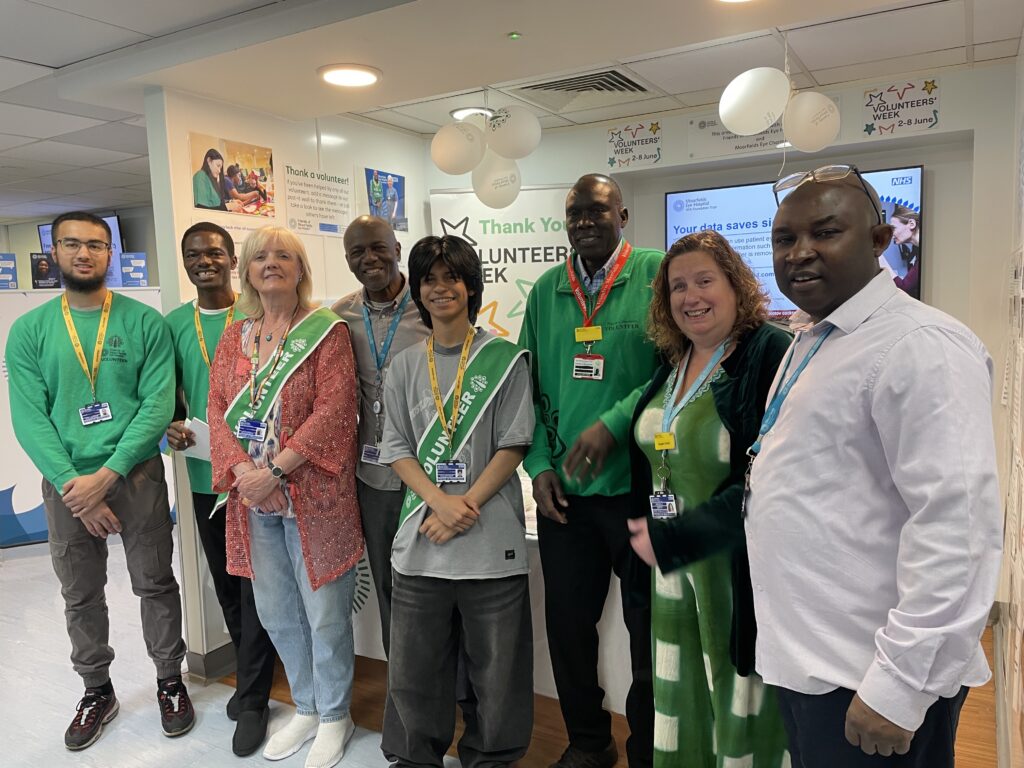
The national week is a celebration of the incredible contributions volunteers make to communities across the UK.
From 2-8 June, we’re celebrating Volunteers’ Week – a chance to recognise, celebrate and thank volunteers for everything they do for local communities, the voluntary sector, and society as a whole.
At Friends of Moorfields we have almost 350 volunteers, working across 10 Moorfields sites and remotely, to give over 1000 hours of support to Moorfields patients and staff.
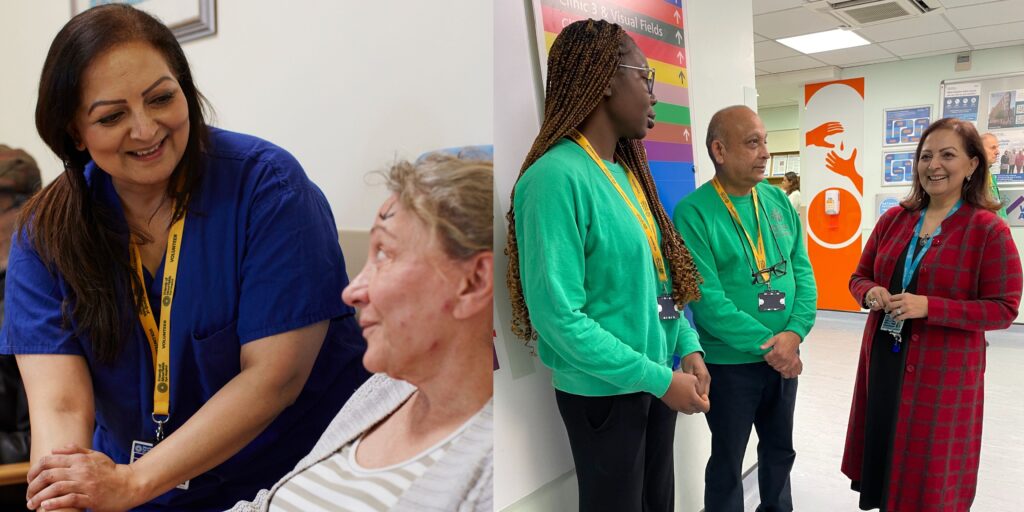
Our volunteers do everything from directing and guiding patients as they arrive, to supporting them before and during procedures, from helping people find the right resources at the Health Information Hub, to making appointment reminder calls to help make sure patients have the right information and clinics run smoothly.
We asked a few of our volunteers what volunteering with us means to them – find out what they said in the video below!
We’re so incredibly proud of our volunteers, and grateful for the fantastic support they provide.
To find out more about what our volunteers do, check out our Volunteer Stories page, and look out for more posts here on the website and on our social media throughout the week.
If you’re interested in volunteering with us, visit our Volunteer page.