
The patient no one talks about
26th February, 2026
An interview with Dr Karla Dias
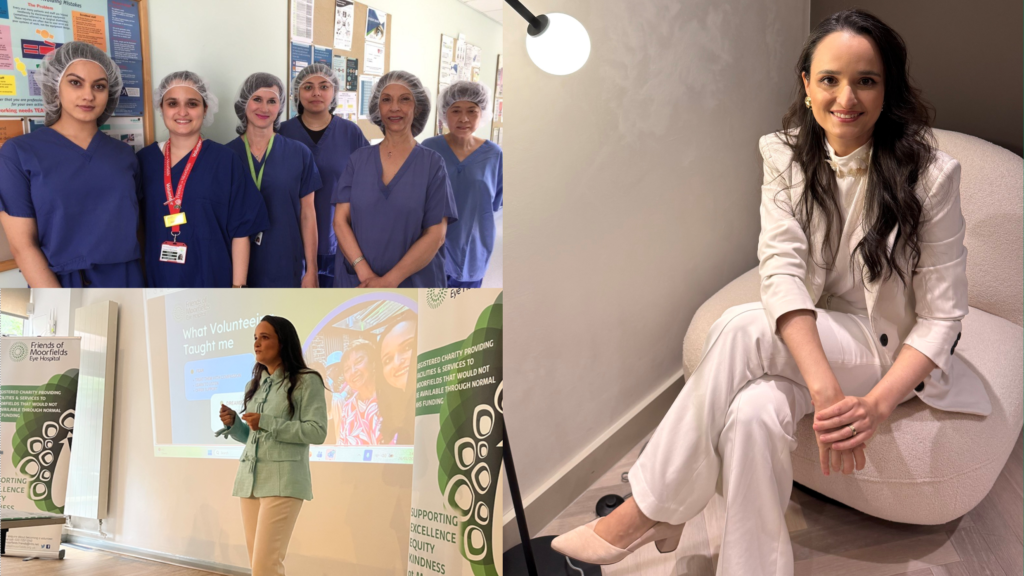
When we talk about the future of eye care, we often think about research labs, the latest equipment and brand-new treatments – which are key to progress. But the best breakthroughs are also about people.
The wonderful Dr. Karla Dias has been with Moorfields for 7 years – 1 year as a volunteer and 6 as a doctor. Friends caught up with her about her background, how breakthroughs happen, and the future of eye care at Moorfields.
Can you tell us a little bit about your specialisation in eye care and your journey at Moorfields?
Thank you very much for inviting me. It’s always a pleasure to speak with the Friends! I’m an ophthalmologist with a particular interest in complex anterior segment disease and structural complications. My work focuses on patients whose eyes have lost their normal pressure and structural integrity. This can happen after surgery, inflammation or eye trauma.
My journey at Moorfields has been deeply formative. It began not only as a clinician, but also as a volunteer. As a volunteer I started with welcoming patients at the front. I would help them check in, guide them, and be there for them if they had questions.
“This experience shaped the type of doctor I am today.”
When you sit next to a patient as a volunteer, you hear different things about their fears of losing independence, their frustrations, and their hopes that someone might look at their case differently. And that perspective has always stayed with me.
At Moorfields, we work at this intersection of clinical excellence, research and compassion. I’m very grateful to have always been given the time to talk to patients, even when I’m in a very busy clinic.
Your relationship with Friends has recently gone full circle, as you are part of the team that was on the news about a new treatment funded by Moorfields Eye Charity, which Angela Smith, our chief executive, received as well. What is hypotony and how does the treatment help patients like Angela?
It’s been a great pleasure to be able to treat her! Hypotony is a condition in which the pressure inside of the eye becomes abnormally low. When this happens, the eye can collapse structurally, leading to distorted vision, changes in the retina, discomfort, and in severe cases, irreversible sight loss.
Low eye pressure is not just a number for many patients. It means blurred vision, fluctuation in the vision, difficulty reading, driving, recognising faces, and dealing with the emotional impact of limited options.
The treatment we developed involves injections inside of the eye with a gel-like substance that provides internal structural support. Rather than trying to increase the pressure by injecting liquid in the front part of the eye, this approach focuses on restoring the eye’s architecture from within, which can ultimately improve visual function.
“For patients like Angela, it represents a shift from ‘there is nothing that we can do’ to ‘there may be a way to help’.”
Can you talk a bit more about how the treatment came about?
Innovation begins with listening carefully to what’s not working. Conventional hypotony treatments aim to correct underlying causes. However, in some patients the eye’s structure remains unstable.
“When patients continue to have hope and ask whether there is another possibility, it challenges us as clinicians to look beyond established pathways. Innovation is often co-created with patients.”
The HPMC gel we use actually has long been used safely in ophthalmology, but the idea to use the gel to treat hypotony emerged from listening to a patient who was losing her vision. Mr. Petrushkin wanted to try everything he could to stop this from happening.
What role does addressing unmet needs, and the effort around rare diseases, play in driving innovation?
Rare and underrepresented conditions often receive less attention in research because they affect smaller populations. Yet for an individual patient, the impact is profound. When there is no treatment, no trial and limited literature, we must think more creatively and more collaboratively as clinicians.
At Moorfields, we work as a team: with patients, multiple clinics and different consultants and colleagues, who always have something to add. I’m respected for being unique and Mr. Petrushkin is respected for having his ideas.
“Being a voice for the patient that no one talks about means recognising that equity is not only about access. Equity is about ensuring that uncommon conditions are not dismissed and unsolvable simply because they are uncommon.”
Historically, some of the most transformative medicine began with rarer and challenging cases that forced us to think differently. When we allow lived experience to guide research priorities, innovation becomes concrete and purposeful.
The hypotony treatment is a good example. It began with a relatively small number of patients with a significant unmet need. But once you explore a solution, its principles may extend to broader applications.
If you had to name one thing, what excites you most about innovation at Moorfields?
If I had to put it into one word, it’s ‘mindset’. At Moorfields, there is a culture that allows clinicians and scientists to question assumptions. This environment, together with the exceptional research infrastructure, multidisciplinary collaboration, and many incredible people working here, creates the space for meaningful change.
“Kindness and innovation are not separate concepts. The future of eye care is not only about new devices and molecules; it’s about the human drive to change the outcomes for patients who feel forgotten or unseen.”
That moment that the patient who has been told for years ‘that nothing can be done’, hears ‘there may be something we can try’, that’s when true progress starts.
If you would like to listen to the full interview, please access the recording here.